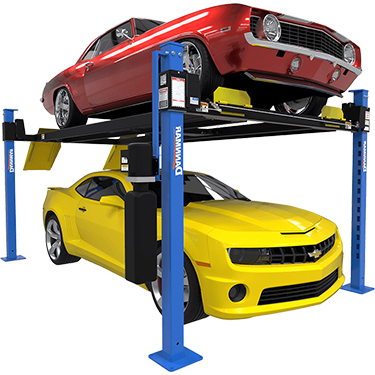
Are bolt-down anchors needed to secure a four-post
lift? At Wrenchers this question comes up often.
The reasons are many. Maybe you do not want to
drill holes into a pristine slab of concrete. Or
maybe you’re not the type who likes long-term
commitments? Wrenchers understands. Rest assured
there are other four-post lift owners like you.
Wrenchers knows you have a lot riding up in the
air. Somedays, it’s your buddy’s new Vette atop
your four-post lift. Other days it might be a
Corolla that was a rental in its previous life.
Maybe you have a four-post in your home garage to
store your really nice Porsche or big-block
Chevelle.
No matter the score, a four-post lift from
Wrenchers is certainly more-than-sturdy and
likewise plants weight at all four columns onto
your concrete slab. But with such hefty and rigid
lift equipment, is it really critical to bolt down
and anchor the lift’s base plates to the concrete?
Quick AnswerIt Depends
Truth is
Wrenchers Four Post lifts
are designed to be used either with or without
bolt-down anchors attached through each base plate.
That said, bolting your lift down does add another
layer of confidence, especially if your work
surroundings flirt with the severe side of lift
use. Or if seismic activities may occur in your
area. Depending on how you plan to use your lift,
you may be able to simply proceed with it in place
on your slab. Before you do though, it is important
to review some additional information.
Hold Tight or Keep Free?
Start With How You Use Your Lift
Consider how the lift will be used, whether mobility
matters, and the types of forces it may experience in
your garage or shop.
01
Do you like to have the easy option to relocate
your four-post lift for working efficiency?
02
Did you know a Caster Kit is available to allow
some four-post lifts to be mobile?
03
Do you use your lift for storage, mechanical
repairs, or maybe body repairs?
04
Do you use heavy-hitting tools to make large
repairs with cable pullers, air chisels, etc.?
05
Does your lift get rigorous use from multiple
techs who drive onto the lift rapidly and stop
quickly?
Everyday Lift Use
Do You Use Your Lift for Everyday Repairs?
Is the lift in your garage typically used for
vehicle service, exhaust system removal, vehicle
storage, or drivetrain repairs? These types of
normal activities are anticipated during lift
engineering and do not raise a concern requiring
that the lift be bolted down to concrete.
Vehicle Service
Exhaust Work
Vehicle Storage
Drivetrain Repairs
Other Forces to Consider
Not Every Load Pushes Straight Down
Lateral Load
Vehicle Movement
Pulling vehicles onto a lift obviously loads
weight downward onto the runways. There is also
another force to consider. In some cases, if a
vehicle is driven onto a lift quickly and the
vehicle’s brakes are then applied abruptly, the
forward force in an extreme case presents an
amount of lateral load.
Know that it is best to have experienced personnel
drive and park a vehicle carefully up on a lift.
Whether it is bolted down or not.
Seismic Activity
Earthquakes
This does not always mean California. In 2020,
Salt Lake City, Utah had a large earthquake roll
through. Western Pennsylvania did have a relatively
small earthquake during the same year.
Although the last two noted are outside the norm,
point is that they can occur just about anywhere.
If you would rather go with the odds that
earthquakes are really unusual events where you
are, know that a Wrenchers’ four post lift is
definitely built strong and supports all of the
rated capacity that you add to it.
If You Bolt Down
Effective Embedment
01
16 holes drilled in concrete — use base plate
as guide.
02
Four expansion sleeves (aka Wedge Anchors)
at each column.
03
Four anchor bolts at each column — torqued
to 85–95 lb.-ft.
04
Provides added lift holding strength.
Best to Consider
Evaluate Your Shop's Use
You will want to evaluate if your shop will use a
four-post lift as many other shops do, or if you may
often perform jobs that place heavier than normal
demands on the four-post lift and its placement.
How Do Things Sit?
Your Concrete Slab Matters
Concrete thickness is important whether you plan
to bolt down your lift or simply place it in a
suitable position and begin lifting vehicles.
Each four-post lift model has its own concrete
requirements that are listed in the respective
user manual. Depending on model and lift capacity
requirements, thicknesses generally range from
4.25” minimum thickness/3,000 PSI to 6.5” minimum
thickness/3,000 PSI and cured for at least 28 days
after pouring.
General Range4.25"–6.5" Minimum Thickness
Concrete Strength3,000 PSI
Cure TimeAt Least 28 Days
Concrete condition is also important. This means
there should not be excessive or large cracks on
concrete. Especially at areas where each base
plate on the lift’s columns set.
Check the Specific Lift Manual
Concrete requirements vary by model and lift
capacity. Use the requirements listed in the
respective lift's user manual for the model
being installed.
Check the Surface
Is Your Concrete Slab on the Level?
Whether you choose to bolt down your four-post lift
or use it resting on your concrete slab, it
definitely needs to be placed on a level slab.
The installation goal is to have the lift as level
as possible with no more than a 3 percent slope on
the concrete.
If the runways on the lift are not level, neither
is the vehicle that is placed on the runways. This
can ultimately affect repair quality and also allow
the vehicle to roll on the runways.
Level concrete is also important if the four-post
lift is fitted with the optional caster kit.
Installation Goal
No More Than a 3% Slope on the Concrete
Want a Portable Lift?
Wrenchers Offers a Four-Post Lift Caster Kit
SKU 5210997
Wrenchers
Caster Kit
makes your Four Post Lift Portable, Versatile, and
Adaptable. Best of all, Wrenchers calls it HELPFUL.
Are there days in your shop when your lift would
serve much better if it were at the other end of
your garage? Maybe a flatbed tow truck is dropping
off a long bed, crew cab with a blown trans and
you need more approach room to load it on your
four-post lift?
Moving your four-post vehicle lift might make
everything easier. If you have your sights set on
Wrenchers Bendpak
HD-7
or
BendPak HD-9
,
know that you can equip either model with a
Caster Kit.
This means that you can skate that big four-post
lift across your concrete slab to a more useful
spot. Did we mention it’s even possible to move
the lift around with a vehicle loaded onboard?
Caster Kit Details
Features & Components
For use on
HD-7
and
HD-9
series four-post vehicle lifts
Set of Four
Provides mobility for easy movement and storage
Can be installed or removed easily
Heavy-duty construction
Helps Free Space
Mounting bar
T-handle rod
Washer (T-handle rod)
Caster wheel
With or Without Anchors?
What's the Bottom Line?
The decision to bolt down your four-post auto lift
largely depends on reasons such as if extreme or
forceful vehicle repairs are sometimes performed
that may laterally stress the lift’s placement.
Or if there is a decent possibility of earthquakes
in your area. And of course, what your comfort
level may be.
In these cases you may decide bolting down your
lift is your best option.
Otherwise, know as an example that lifts such as a
9,000-lb. capacity HD-9 lift remains safe and ALI
certified without anchor bolts. This means even
busy auto repair shops can typically and safely
raise vehicles on four-post vehicle lifts that are
not bolted into position.
Find Your Four-Post Lift
Wrenchers Has Plenty to Choose From
Wrenchers offers four-post lifts with capacities
that range from 7,000 lbs. up to 40,000 lbs. with
a variety of different lift capacities in between.
The good news is that a four post lift from
Wrenchers will always perform well when installed
to best match your shop’s need.
Are bolt-down anchors needed to secure a four-post
lift? At Wrenchers this question comes up often.
The reasons are many. Maybe you do not want to
drill holes into a pristine slab of concrete. Or
maybe you’re not the type who likes long-term
commitments? Wrenchers understands. Rest assured
there are other four-post lift owners like you.
Wrenchers knows you have a lot riding up in the
air. Somedays, it’s your buddy’s new Vette atop
your four-post lift. Other days it might be a
Corolla that was a rental in its previous life.
Maybe you have a four-post in your home garage to
store your really nice Porsche or big-block
Chevelle.
No matter the score, a four-post lift from
Wrenchers is certainly more-than-sturdy and
likewise plants weight at all four columns onto
your concrete slab. But with such hefty and rigid
lift equipment, is it really critical to bolt down
and anchor the lift’s base plates to the concrete?
Quick Answer
It Depends
Truth is
Wrenchers Four Post lifts
are designed to be used either with or without
bolt-down anchors attached through each base plate.
That said, bolting your lift down does add another
layer of confidence, especially if your work
surroundings flirt with the severe side of lift
use. Or if seismic activities may occur in your
area. Depending on how you plan to use your lift,
you may be able to simply proceed with it in place
on your slab. Before you do though, it is important
to review some additional information.
Hold Tight or Keep Free?
Start With How You Use Your Lift
Consider how the lift will be used, whether mobility
matters, and the types of forces it may experience in
your garage or shop.
01
Do you like to have the easy option to relocate
your four-post lift for working efficiency?
02
Did you know a Caster Kit is available to allow
some four-post lifts to be mobile?
03
Do you use your lift for storage, mechanical
repairs, or maybe body repairs?
04
Do you use heavy-hitting tools to make large
repairs with cable pullers, air chisels, etc.?
05
Does your lift get rigorous use from multiple
techs who drive onto the lift rapidly and stop
quickly?
Everyday Lift Use
Do You Use Your Lift for Everyday Repairs?
Is the lift in your garage typically used for
vehicle service, exhaust system removal, vehicle
storage, or drivetrain repairs? These types of
normal activities are anticipated during lift
engineering and do not raise a concern requiring
that the lift be bolted down to concrete.
Vehicle Service
Exhaust Work
Vehicle Storage
Drivetrain Repairs
Other Forces to Consider
Not Every Load Pushes Straight Down
Lateral Load
Vehicle Movement
Pulling vehicles onto a lift obviously loads
weight downward onto the runways. There is also
another force to consider. In some cases, if a
vehicle is driven onto a lift quickly and the
vehicle’s brakes are then applied abruptly, the
forward force in an extreme case presents an
amount of lateral load.
Know that it is best to have experienced personnel
drive and park a vehicle carefully up on a lift.
Whether it is bolted down or not.
Seismic Activity
Earthquakes
This does not always mean California. In 2020,
Salt Lake City, Utah had a large earthquake roll
through. Western Pennsylvania did have a relatively
small earthquake during the same year.
Although the last two noted are outside the norm,
point is that they can occur just about anywhere.
If you would rather go with the odds that
earthquakes are really unusual events where you
are, know that a Wrenchers’ four post lift is
definitely built strong and supports all of the
rated capacity that you add to it.
If You Bolt Down
Effective Embedment
01
16 holes drilled in concrete — use base plate
as guide.
02
Four expansion sleeves (aka Wedge Anchors)
at each column.
03
Four anchor bolts at each column — torqued
to 85–95 lb.-ft.
04
Provides added lift holding strength.
Best to Consider
Evaluate Your Shop's Use
You will want to evaluate if your shop will use a
four-post lift as many other shops do, or if you may
often perform jobs that place heavier than normal
demands on the four-post lift and its placement.
How Do Things Sit?
Your Concrete Slab Matters
Concrete thickness is important whether you plan
to bolt down your lift or simply place it in a
suitable position and begin lifting vehicles.
Each four-post lift model has its own concrete
requirements that are listed in the respective
user manual. Depending on model and lift capacity
requirements, thicknesses generally range from
4.25” minimum thickness/3,000 PSI to 6.5” minimum
thickness/3,000 PSI and cured for at least 28 days
after pouring.
General Range
4.25"–6.5" Minimum Thickness
Concrete Strength
3,000 PSI
Cure Time
At Least 28 Days
Concrete condition is also important. This means
there should not be excessive or large cracks on
concrete. Especially at areas where each base
plate on the lift’s columns set.
Check the Specific Lift Manual
Concrete requirements vary by model and lift
capacity. Use the requirements listed in the
respective lift's user manual for the model
being installed.
Check the Surface
Is Your Concrete Slab on the Level?
Whether you choose to bolt down your four-post lift
or use it resting on your concrete slab, it
definitely needs to be placed on a level slab.
The installation goal is to have the lift as level
as possible with no more than a 3 percent slope on
the concrete.
If the runways on the lift are not level, neither
is the vehicle that is placed on the runways. This
can ultimately affect repair quality and also allow
the vehicle to roll on the runways.
Level concrete is also important if the four-post
lift is fitted with the optional caster kit.
Installation Goal
No More Than a 3% Slope on the Concrete
Want a Portable Lift?
Wrenchers Offers a Four-Post Lift Caster Kit
SKU 5210997
Wrenchers
Caster Kit
makes your Four Post Lift Portable, Versatile, and
Adaptable. Best of all, Wrenchers calls it HELPFUL.
Are there days in your shop when your lift would
serve much better if it were at the other end of
your garage? Maybe a flatbed tow truck is dropping
off a long bed, crew cab with a blown trans and
you need more approach room to load it on your
four-post lift?
Moving your four-post vehicle lift might make
everything easier. If you have your sights set on
Wrenchers Bendpak
HD-7
or
BendPak HD-9
,
know that you can equip either model with a
Caster Kit.
This means that you can skate that big four-post
lift across your concrete slab to a more useful
spot. Did we mention it’s even possible to move
the lift around with a vehicle loaded onboard?
Caster Kit Details
Features & Components
For use on
HD-7
and
HD-9
series four-post vehicle lifts
Set of Four
Provides mobility for easy movement and storage
Can be installed or removed easily
Heavy-duty construction
Helps Free Space
Mounting bar
T-handle rod
Washer (T-handle rod)
Caster wheel
With or Without Anchors?
What's the Bottom Line?
The decision to bolt down your four-post auto lift
largely depends on reasons such as if extreme or
forceful vehicle repairs are sometimes performed
that may laterally stress the lift’s placement.
Or if there is a decent possibility of earthquakes
in your area. And of course, what your comfort
level may be.
In these cases you may decide bolting down your
lift is your best option.
Otherwise, know as an example that lifts such as a
9,000-lb. capacity HD-9 lift remains safe and ALI
certified without anchor bolts. This means even
busy auto repair shops can typically and safely
raise vehicles on four-post vehicle lifts that are
not bolted into position.
Find Your Four-Post Lift
Wrenchers Has Plenty to Choose From
Wrenchers offers four-post lifts with capacities
that range from 7,000 lbs. up to 40,000 lbs. with
a variety of different lift capacities in between.
The good news is that a four post lift from
Wrenchers will always perform well when installed
to best match your shop’s need.
Are bolt-down anchors needed to secure a four-post lift? At Wrenchers this question comes up often. The reasons are many. Maybe you do not want to drill holes into a pristine slab of concrete. Or maybe you’re not the type who likes long-term commitments? Wrenchers understands. Rest assured there are other four-post lift owners like you.
Wrenchers knows you have a lot riding up in the air. Somedays, it’s your buddy’s new Vette atop your four-post lift. Other days it might be a Corolla that was a rental in its previous life. Maybe you have a four-post in your home garage to store your really nice Porsche or big-block Chevelle. No matter the score, a four-post lift from Wrenchers is certainly more-than-sturdy and likewise plants weight at all four columns onto your concrete slab. But with such hefty and rigid lift equipment, is it really critical to bolt down and anchor the lift’s base plates to the concrete?
Truth is Wrenchers Four Post lifts are designed to be used either with or without bolt-down anchors attached through each base plate. That said, bolting your lift down does add another layer of confidence, especially if your work surroundings flirt with the severe side of lift use. Or if seismic activities may occur in your area. Depending on how you plan to use your lift, you may be able to simply proceed with it in place on your slab. Before you do though, it is important to review some additional information.
Hold Tight or Keep Free?
Do you like to have the easy option to relocate your four-post lift for working efficiency?
Did you know a Caster Kit is available to allow some four-post lifts to be mobile?
Do you use your lift for storage, mechanical repairs, or maybe body repairs?
Do you use heavy-hitting tools to make large repairs with cable pullers, air chisels, etc.?
Does your lift get rigorous use from multiple techs who drive onto the lift rapidly and stop quickly?
Do you use your lift for everyday type repairs?
Is the lift in your garage typically used for vehicle service, exhaust system removal, vehicle storage, or drivetrain repairs? These types of normal activities are anticipated during lift engineering and do not raise a concern requiring that the lift be bolted down to concrete.
There are other forces to consider
Pulling vehicles onto a lift obviously loads weight downward onto the runways. There is also another force to consider. In some cases, if a vehicle is driven onto a lift quickly and the vehicle’s brakes are then applied abruptly, the forward force in an extreme case presents an amount of lateral load. Know that it is best to have experienced personnel drive and park a vehicle carefully up on a lift. Whether it is bolted down or not.
Do earthquakes ever occur in your area?
This does not always mean California. In 2020, Salt Lake City, Utah had a large earthquake roll through. Western Pennsylvania did have a relatively small earthquake during the same year. Although the last two noted are outside the norm, point is that they can occur just about anywhere. If you would rather go with the odds that earthquakes are really unusual events where you are, know that a Wrenchers’ four post lift is definitely built strong and supports all of the rated capacity that you add to it.
If you bolt down, here are some key items and features to achieve Effective Embedment:
16 holes drilled in concrete-use base plate as guide
Four Expansion sleeves (aka Wedge Anchors) at each column
Four Anchor bolts at each column-torqued to 85-95 lb.-ft.
Provides Added Lift Holding strength
Best to Consider
You will want to evaluate if your shop will use a four-post lift as many other shops do, or if you may often perform jobs that place heavier than normal demands on the four-post lift and its placement.
How Do Things Sit?
Concrete thickness is important whether you plan to bolt down your lift or simply place it in a suitable position and begin lifting vehicles. Each four-post lift model has its own concrete requirements that are listed in the respective user manual. Depending on model and lift capacity requirements, thicknesses generally range from 4.25” minimum thickness/3,000 PSI to 6.5” minimum thickness/3,000 PSI and cured for at least 28 days after pouring. Concrete condition is also important. This means there should not be excessive or large cracks on concrete. Especially at areas where each base plate on the lift’s columns set.
Is Your Concrete Slab On the Level?
Whether you choose to bolt down your four-post lift or use it resting on your concrete slab, it definitely needs to be placed on a level slab. The installation goal is to have the lift as level as possible with no more than a 3 percent slope on the concrete. If the runways on the lift are not level, neither is the vehicle that is placed on the runways. This can ultimately affect repair quality and also allow the vehicle to roll on the runways. Level concrete is also important if the four-post lift is fitted with the optional caster kit.
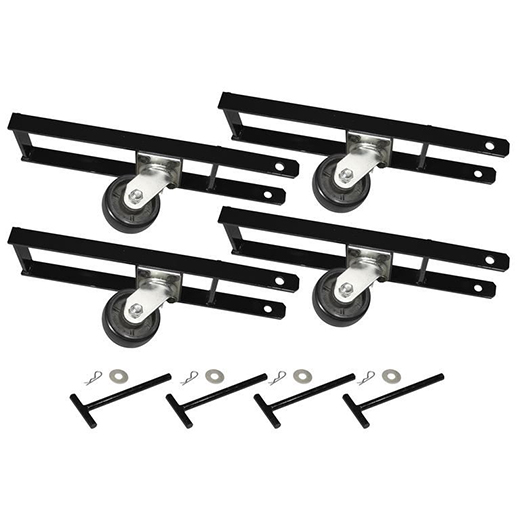
Wrenchers offers a Caster Kit that makes your lift PORTABLE (SKU 5210997)
Wrenchers Caster Kit makes your Four Post Lift Portable, Versatile, and Adaptable. Best of all, Wrenchers calls it HELPFUL. Are there days in your shop when your lift would serve much better if it were at the other end of your garage? Maybe a flatbed tow truck is dropping off a long bed, crew cab with a blown trans and you need more approach room to load it on your four-post lift?
Going Mobile?
Moving your four-post vehicle lift might make everything easier. If you have your sights set on Wrenchers Bendpak HD-7 or BendPak HD-9, know that you can equip either model with a Caster Kit. This means that you can skate that big four-post lift across your concrete slab to a more useful spot. Did we mention it’s even possible to move the lift around with a vehicle loaded onboard?
If you bolt down, here are some key items and features to achieve Effective Embedment:
For use on HD-7 and HD-9 series four-post vehicle lift
Set of Four
Provides mobility for easy movement and storage
Can be installed or removed easily
Heavy-duty construction
Helps Free Space
Mounting bar
T-handle rod
Washer (T-handle rod)
T-handle rod
Caster wheel
With or Without Bolted Down Anchors-What’s the Bottom Line?
The decision to bolt down your four-post auto lift largely depends on reasons such as if extreme or forceful vehicle repairs are sometimes performed that may laterally stress the lift’s placement. Or if there is a decent possibility of earthquakes in your area. And of course, what your comfort level may be. In these cases you may decide bolting down your lift is your best option.
Otherwise, know as an example that lifts such as a 9,000-lb. capacity HD-9 lift remains safe and ALI certified without anchor bolts. This means even busy auto repair shops can typically and safely raise vehicles on four-post vehicle lifts that are not bolted into position.
If you need a four-post auto lift, Wrenchers has plenty to choose from
Wrenchers offers four-post lifts with capacities that range from 7,000 lbs. up to 40,000 lbs. with a variety of different lift capacities in between. The good news is that a four post lift from Wrenchers will always perform well when installed to best match your shop’s need.