
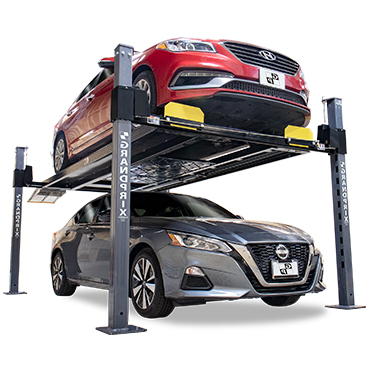
Four-Post Lift Safety Locks
Compressed Air Lock vs. Manual Lock Systems
Explore how four-post lift safety locks work, how each release system operates, and which setup may better match your garage or shop.
Four-Post Lift Safety
Understanding the Locking System
Are you looking forward to installing a four-post vehicle lift in your garage or shop? Auto lifts are a fundamental “must have” if you are either in the car repair biz or an intense hobbyist. Simply rack the car, raise it, and continue on.
Safety is always paramount and is why as the lift’s platform rises, automatic spring-loaded safety locks engage repeatedly as they ratchet higher to each column’s “ladder” of stamped openings. As an additional safety measure, a back-up slack cable system allows instant lock engagement in the outside chance a main-cable stops working.
Once the lift’s platform is at the desired height, the operator slightly adjusts the platform a few inches down so that the spring-loaded safety locks engage into the next-available opening moving downward. Thus firmly holding the platform above ground and in secure position to allow worry-free undercar working access.
Release Basics
How Four-Post Lift Safety Locks Release
When it is time to lower the lift’s platform back down, a two-step releasing process is performed. This releasing process is triggered by the lift’s operator at the power post either with a Compressed Air Lock system via pushing a pneumatically operated button to free safety locks, or with a Manual Lock system that uses a lever’s movement to free in-place safety locks.
No matter which safety lock release system is incorporated with the lift’s model, all four safety locks must be freed at the same time before the runways can travel back down.
Begin by raising the lift platform slightly from its locked position.
Push the compressed-air release button or operate the manual safety-lock release handle to free all four locks.
While the safety locks remain released, operate the lowering lever so the platform can travel downward.
Which system is better to release the safety locks: Compressed Air Locks or Manual Locks? The short answer is, “it depends.” Your shop’s daily pace, workload, available air supply and the type of work performed can influence which system better matches the setting.
Choosing a System
What Is Your Work Setting Like?
Wrenchers has some helpful information to help you choose which style may serve your shop better. Your shop’s daily pace, workload, and the type of work that is performed in your garage will largely influence if Compressed Air Locks or Manual Locks should be used.
For example, is your shop a busy place like a tire store where more than one car per hour is on the lift? Do multiple techs frequently operate the lift? Is the shop’s setting one that readily has air available nearby?
Or maybe your compressor is located at the other end of the shop and the lift you have is used mainly for long-term jobs. Maybe partial restorations on classic cars? The choice often comes down to your work day’s stride and shop environment.
How frequently will the lift be used?
Will multiple technicians operate it?
Is compressed air readily available nearby?
Will vehicles stay on the lift for longer repair or restoration jobs?

Option 01
Compressed Air Lock Systems
Is your shop always on the go? Maybe busy brake and tire repairs with multiple techs operating the same lift? To operate, simply raise the lift from its parked position a few inches, push the pneumatic release button, and then press down and hold the lowering handle.
A Compressed Air Lock system requires air pressure to operate, but not much. Just about 25 psi routes from your shop’s air tank and into small aircraft-quality stainless steel and aluminum pneumatic cylinders. The pressure is then delivered to release all four locks simultaneously.
Although it requires an air pressure source, it does not require a large volume high-pressure system to operate. The pneumatic push button is conveniently located on the power post.
Compressed Air Lock Models
Four-Post Lifts With Compressed Air Locks
Option 02
Manual Lock Systems
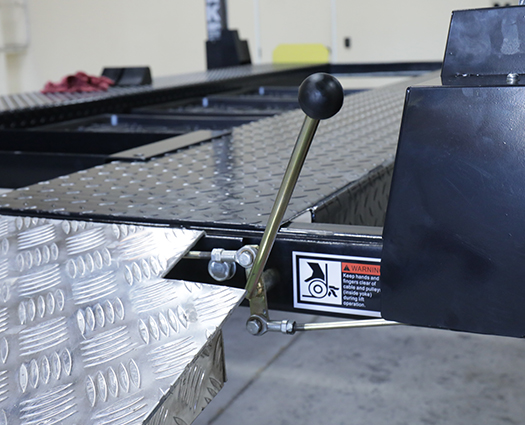
Manual Lock systems work well in shops as a secondary lift or for longer term automotive work. Sometimes a Manual Lock system will serve better in a shop where vehicles stay on lifts longer and air supply infrastructure is not readily available.
A Manual Lock system is straightforward to use. Raise the lift from its parked position a few inches, pull down and hold the safety lock release handle first, and then press down and hold the lowering handle.
Manual Lock Models
Four-Post Lifts With Manual Locks
Manual Lock system releases found on Grand Prix and Dannmar four-post lifts might not seem fancy, but they achieve the same result. If your garage does not have readily available air, you can still have the many benefits of open undercar access to make wheels-free repairs without extra air lines in the same area. Manual Lock systems still have plenty of locking positions on the columns to safely position the lift at any available level you choose for helpful undercar access.
Lock In the Right Choice
Match the System to Your Shop
Wrenchers offers a variety of four-post lifts from BendPak, GrandPrix, and Dannmar with both Compressed Air Lock and Manual Lock systems. In basic terms, a busy shop might be served better with a Compressed Air Lock lift and a shop or garage that spends more time on each car may do well with a Manual Lock system lift. As with a lot of shop equipment, one style can serve better in one setting and another style can serve better in another setting. Armed with useful Wrenchers information, you can lock in your right choice.
Wrenchers Explores the Differences of Compressed Air Lock and Manual Lock Systems
Are you looking forward to installing a four-post vehicle lift in your garage or shop? Auto lifts are a fundamental “must have” if you are either in the car repair biz or an intense hobbyist. Simply rack the car, raise it, and continue on.
Safety is always paramount and is why as the lift’s platform rises, automatic spring-loaded safety locks engage repeatedly as they ratchet higher to each column’s “ladder” of stamped openings. As an additional safety measure, a back-up slack cable system allows instant lock engagement in the outside chance a main-cable stops working. Lift manufactures realized these needed safety benefits the first moment they sat down to design an above-ground auto lift.
Once the lift’s platform is at the desired height, the operator slightly adjusts the platform a few inches down so that the spring-loaded safety locks engage into the next-available opening moving downward. Thus firmly holding the platform above ground and in secure position to allow worry-free undercar working access
Compressed Air Lock and Manual Lock Systems Release Basics:
When it is time to lower the lift’s platform back down, a two-step releasing process is performed. This releasing process is triggered by the lift’s operator at the power post either with a Compressed Air Lock system via pushing a pneumatically operated button to free safety locks, or with a Manual Lock system that uses a lever’s movement to free in-place safety locks.
Why? Because no matter which safety lock release system is incorporated with the lift’s model, the process dictates that all four safety locks be freed at the same time first so the runways can travel back down. In more detail, each of these lock systems require two lift lowering actions to complete. To move the lift’s platform down from any above ground lift platform position, the operator begins by first raising the platform slightly, and then pushing the Compressed Air Lock button or Manual Lock system safety lock release handle to discharge all safety locks at once. While the safety locks are pulled out, the lift’s platform is free to move downward once the lift operator moves a lowering lever. With these operations underway, the lift’s platform travels downward.
Which system is better to release the safety locks though; Compressed Air Locks or Manual Locks? The short answer is, “it depends”.
Choosing Compressed Air Locks or Manual Locks?
What is Your Work Setting Like?
Wrenchers has some helpful information to help you choose which style may serve your shop better. But know that your shop’s daily pace, workload, and the type of work that is performed in your garage will largely influence if Compressed Air Locks or Manual Locks should be used.
For example, is your shop a busy place like a tire store where more than one car per hour is on the lift? Do multiple techs frequently operate the lift? Is the shop’s setting one that readily has air available nearby?
Or maybe your compressor is located at the other end of the shop and the lift you have is used mainly for long-term jobs. Maybe partial restorations on classic cars? The choice often comes down to your work day’s stride and shop environment.
Here are some helpful points to consider when deciding between a lift that uses Compressed Air Locks systems or a Manual Lock system.
Compressed Air Lock systems:
Is your shop always on the go? Maybe busy brake and tire repairs with multiple techs operating the same lift? To operate, simply raise the lift from its parked position a few inches, push the pneumatic release button, and then press down and hold the lowering handle.
A Compressed Air Lock system obviously requires air pressure to operate, but not much. Just about 25 psi that routes from your shop’s air tank and into small aircraft-quality stainless steel and aluminum pneumatic cylinders. The pressure is then delivered to release all four locks simultaneously. So although it requires an air pressure source, it does not require a large volume high-pressure system to operate. That simple to use pneumatic push button is conveniently located on the power post.
Compressed Air Lock systems work well in settings that include the work settings as listed below or are similar.
- Is the lift used in a commercial garage for primary and frequent use?
- Is there compressed air nearby?
- Is an air compressor frequently available when work is occurring in the shop?
- Do techs work under heavy time constraints
- BendPak HD-7P Compressed Air Locks
- BendPak HD-7W Compressed Air Locks
- BendPak HD-7500-BLX Compressed Air Locks
- BendPak HD-7PXW Compressed Air Locks
- BendPak HD-9 Compressed Air Locks
- BendPak HD-9ST Compressed Air Locks
- BendPak HD-9STX Compressed Air Locks
Manual Lock systems:
Manual Lock systems work well in shops as a secondary lift or for longer term automotive work. Sometimes a Manual Lock system will serve better in a shop where vehicles stay on lifts longer and air supply infrastructure is not readily available. A Manual Lock system is straightforward to use. As mentioned, it is simple to use. Raise the lift from its parked position a few inches, pull down and hold the safety lock release handle first, and then press down and hold the lowering handle.
- Is the lift used in a commercial shop as a secondary lift and away from installed air sources?
- Is the lift used in a home garage?
- Is the lift used infrequently?
- Is the lift used for auto restoration work or exotic cars?
Manual Lock system releases found on Grand Prix and Dannmar four-post lifts might not seem fancy, but they achieve the same result. If your garage does not have readily available air, you can still have the many benefits still of open undercar access to make wheels free repairs. And you don’t need to have extra air lines in the same area. Manual Lock systems still have plenty of locking positions on the columns to safely position the lift at any available level you choose for helpful undercar access.
- GrandPrix-GP-9F Manual Locks
- GrandPrix-GP-9XLT Manual Locks
- Dannmar D4-9 Manual Locks
- Dannmar D4-9X Manual Locks
Wrenchers offers a variety four post lifts from BendPak, GrandPrix, and Dannmar with both Compressed Air Lock and Manual Lock systems. In basic terms, a busy shop might be served better with a Compressed Air Lock lift and a shop or garage that spends more time on each car may do well with a Manual Lock system lift. As with a lot of shop equipment, one style can serve better in one setting and another style can serve better in one other setting. Armed with useful Wrenchers information, you can lock in your right choice.