Buying a Two-Post Car Lift?
Wrenchers Helps Raise your Automotive Work Performance
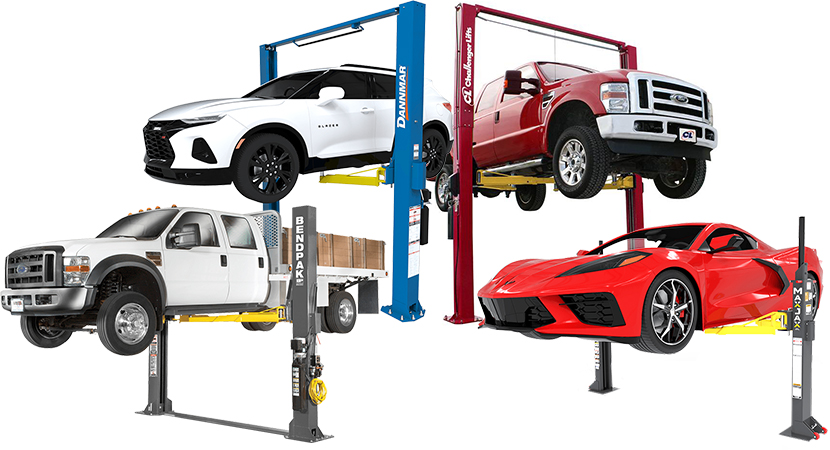
You love to work on cars. At Wrenchers we understand this because we do too. And with all the automotive work you do, you’ve decided it’s time to buy a two-post car lift. Your reasons are simple. With a two-post car lift you just rack the car, raise it, turn on the songs, and start wrenching with plenty of wheels-free, under car access. Yes, it’s much easier to work with a two-post car lift than it is to work without one. OK, you already knew that part, but what are the helpful details to know before you buy one? Proper weight capacity, overhead clearance, a suitable concrete slab and more are just some of the areas to explore.
Wrenchers is here to help as our decades long working experience extends to brands like BendPak, GrandPrix, MaxJax, Dannmar and more. This way we are able to provide you with realistic information you expect when selecting your two-post car lift, plus they are available at value-pricing. Once you have decided which lift will work best for you, it’s easy to reach us either online or via telephone to buy your two-post car lift.
Our Wrenchers website is packed with a large assortment of two-post car lifts and plenty of other shop products and accessories to outfit your shop or garage. As a matter of fact Wrenchers.com looks more like a holiday shopping list for car enthusiasts. We think you will enjoy looking through this site year round though.
Here are 10 key points to consider before buying a two-post car lift:
- Vehicle weights
- Vehicle sizes
- Overhead or Floorplate style (routing location of lines and cables between posts)
- Shop floor dimensions and ceiling height
- Two-post car lift’s overall height, width, and rise
- Concrete Slab type (traditional of post tension) and slab thickness
- Vehicle repairs typically performed
- Drive-up approach area to garage
- Garage door clearance (open and closed)
- Surrounding garage inside area use
By simply taking a few moments, looking at your shop, garage floor, cars you typically work on, and checking how much room you have with your tape measure, you can have a good idea of what will work best.
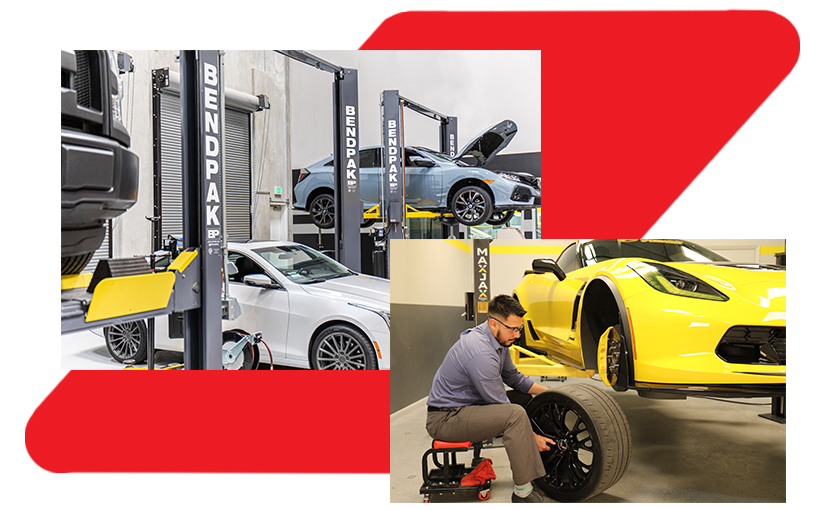
Some Important Specs and Features to Consider
Lifting Capacity
Wrenchers offers two-post car lifts that range from 7,000 lb. lifting capacities up through 18,000 lbs. Typical home use or work shop lift capacities target the 7,000 to 10,000 lb. range and these can handle most SUV’s, light pickup trucks, and passenger cars. Over 10,000 lb. weight vehicles are almost always robust commercial work trucks, work vans, etc. Remember too that sometimes a work truck may be loaded with tools, larger wheels, tires, extra fuel tanks, and equipment that can easily increase vehicle weights. If you anticipate using a two-post car lift for a wide variety of vehicle weights, it is best to match capacity to accommodate these upper weight ranges.
Choosing the right lift capacity is important in your buying decision. Check out our Two Post Weight Capacity Guide
Slab Thickness and Type of Slab
The required thickness of the concrete will need to be determined before anchoring down a lift to a slab. Sometimes an inconspicuous out of the way pilot hole can be drilled to identify the concrete’s depth. For lifts beginning at 7,000 lb. capacity, the thickness should generally be 4.25”, but you will need to verify needed slab thickness per the lift model and the actual concrete you will be working on. Obviously, as lift capacity ratings increase, the demands on the concrete slab have a potential to take on heavier loads when holding larger vehicles. Consequently, thickness requirements may increase. For more concrete required info, see respective lift’s manual (often found online) for specs.
Is the slab a post tension?
Note that it is also important to determine if the concrete slab is a post-tension slab or a traditional slab. If it is post tension, the slab will need to be “mapped out” by a professional or by referencing a building document to identify below surface cable paths. The reason determining this is important is because when anchor holes are drilled into a concrete slab, blindly drilling through or cutting into a post tension cable can cause extensive damage or injury if the cable is hit from drilling and releases. The goods news though is that once the appropriate anchoring area has been determined, drilling and bolting down the lift columns is fairly straightforward.
Rise
This is the dimension that the lift arms will raise up above the concrete. The ‘Rise’ measurement is determined with the lift arms raised at full height and the distance from the top of the concrete to the bottom of the lift arms. This also will tell you how much working room you will have under a given lift when a car is raised on it.
Overall Height
How much under-ceiling room is there? This dimension is the distance measured from the concrete up to the very top of the lift. This means either to the top of the posts or the top of the overhead assembly, whichever is higher. Note that this dimension will obviously need to fit under the ceiling area. Remember too that the height of the vehicle on the lift at max height, with an open top (floorplate style lift) will need to be evaluated before lifting.
Overall Width
This dimension needs to allow lift placement between shops areas, but also if the lift is placed next to a wall the dimension from the wall to the outer column is important. If possible you will want to leave enough room to walk to the front through this area, and also to move important equipment without contacting the lift’s column or the side of an automobile.
Overhead or Floorplate
Within the world of two-post car lifts, there are 2 ways to route the hydraulic and/or lifting cables from the power post to the opposite post. The two methods are via an overhead assembly or a floorplate assembly. Each type offers different working features.
Approach to Garage
Before selecting where to install your lift within a shop or a garage, evaluate the drive-up area and typical angle a vehicle will approach from or back out to. You may want to position a representatively sized vehicle in that area. You might also want to consider that sometimes a vehicle that is being repaired needs to be rolled off of the lift and parked outdoors while waiting for parts to arrive. It is also advisable to determine if the anticipated area is close to doorways or other areas where people may be walking through while a car is on the lift. Keep safety in mind.
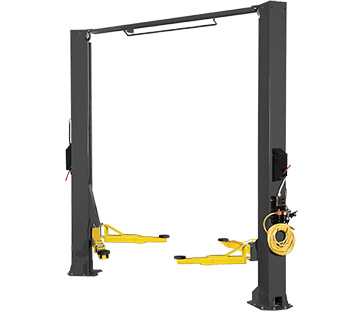
An Overhead Assembly routes hydraulic lines and or cables (or some models a single overhead hydraulic cylinder) through a panel (or similar structure) across the top between the two posts (columns). The main benefit of this style is that it leaves the floor area between the two posts unobstructed and open so that a rollaway toolbox can be moved across the concrete in that area. Hence, another term for an Overhead style is a Clearfloor.
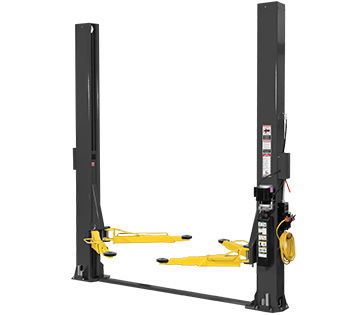
A Floorplate Assembly routes the hydraulic lines and or cables from the power post to the opposite post through a rugged, drive-over enclosure. The benefit of this style is that it leaves the area between the tops of both posts open. This can be helpful if you raise higher vehicles where upward clearance close.
Symmetric and Asymmetric Column Placement
Both symmetric and asymmetric are terms that refer to the opposing angles of each post or column to the opposite post or column. With a symmetrical column, each is squared to the other. With asymmetric columns, each is 30-degrees rotated with the larger opening toward the rear. These rotated (clocked) angles provide added door-opening clearance.
Asymmetric vs Symmetric Two Post Lifts
Adjustable Top Beam and Height Extenders
If you work on a variety vehicles and at times would like to have the option to install your lift in two different widths, you may want to consider a lift with an adjustable top beam. On some BendPak XPR overhead assembly models, you can choose optional height extenders to accommodate higher rise vehicles.
