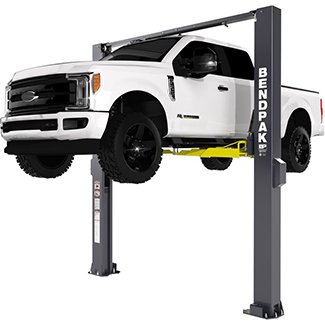
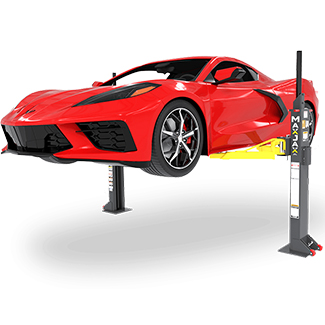
Which Lifting-Arm Configuration Works Best for Your Shop?
Understand the differences between symmetric,
asymmetric, Bi-Metric and Tru-Metric lift arm
configurations before choosing a two-post lift
for the vehicles your shop services.
Think of it as the perfect marriage of geometric
angles, and all of them available from Wrenchers.
When a two-post auto lift has the right
lifting-arm-configuration and corresponding
chassis-lift-point design, there is a welcome
blend of vehicle balance and lift-pad contact.
Different lifting arm configurations are accurately
termed Symmetric, Asymmetric, Bi-Metric, or
Tru-Metric, and each style in the right application
can perform above the rest.
Within the correct parameters, vehicles can set
properly on the lift arm pads, doors can open
without much conflict near the columns, and the
lift’s operation can work well as a team player
within your busy day.
!
Before Selecting a Configuration
Total vehicle length, vehicle weight, and where
the center of gravity rests are important aspects
to know before selecting a lifting arm configuration.
Configuration Basics
Typical Vehicle Positioning
Lift arm configuration generally works as a system
with the two-post lift, including the position and
installed angle of the lift columns.
Symmetric
Vehicle Centered at the Columns
Longer, heavier, rear wheel drive vehicle
with center of gravity generally at the
vehicle’s mid-point. Centerline of vehicle
at column, posts are squared to each other.
Asymmetric
Vehicle Positioned Behind the Columns
Vehicles with most weight resting near the
front-door hinge area. Centerline of vehicle
behind column, posts are rotated 30-degrees
outward for easier vehicle access.
Before You Choose
Selecting the Lifting Arm Configuration for Vehicles You Work On
01
Look at Your Vehicle Mix
Glance through your last month’s repair orders.
Determine whether your shop typically handles
commuter vehicles, heavier pickup trucks or a
broad mix of vehicle types.
02
Stay on Balance
Consider where the center of gravity generally
exists on the cars and trucks you lift: toward
the front, near the middle, or toward the rear.
03
Consider Lift Style & Capacity
Determine which weight-class capacity and lift
style, such as Clearfloor or Floorplate, will
serve your shop before narrowing your available
arm configurations.
Watch Your Weight
General Vehicle Weight-Bias Guidelines
Vehicle weight distribution is one factor to consider
along with the lifting capacity of the lift you select.
Approx. 50 / 50 Balance
Weight Rests Toward the Middle
Front engine, rear wheel drive, larger size
vehicles. Examples include full-size RWD sedans,
pick-up trucks — typically crew-cab and/or long
bed — full-size SUVs and full-size work vans.
A Symmetric Lift Arm Configuration generally
works well with 50/50 weight balance.
Approx. 60 / 40 Balance
Weight Rests Toward the Front
Front wheel drive vehicles, transverse-mounted
engine and transmission configurations, and
standard ½-ton pickup trucks. Examples include
FWD two- and four-door sedans, smaller FWD SUVs
and full-size two-door short-bed 2WD pickups.
An Asymmetric Lift Arm Configuration generally
works well with 60/40 weight balance.
Compare the Designs
Lift Arm Configuration Terms in More Detail
Configuration 01
Symmetric Lift Arm Configurations
A “Symmetric” lift arm configuration principally
means all four lift arms pivot from columns that
are squarely placed across from each other. In
other words, both opposing sides of a two-post
lift share the same geometry.
The lift arms are configured with approximately
the same length, and can often be adjusted to
identical lengths.
Columns are positioned squarely to each other
Lift arms squarely pivot at columns and are
approximately the same length
Design works best with vehicles that generally
have a mid-point center of gravity
Symmetric lifts offered in either Overhead
or Floorplate design
Works well with larger RWD vehicles, SUVs,
½, ¾, 1 ton crew cab trucks and vans
On some cars, the door may be in line with
the post, making it difficult to open doors
Symmetric lifts are largely used for servicing
vehicles that carry their weight almost evenly
from bumper to bumper. Larger rear wheel drive
vehicles are typical of what works well with
this style.
Note too that a symmetric lift’s arms can most
often be adjusted to accommodate and lift a
smaller front wheel drive vehicle. Albeit most
front wheel drive vehicles balance on the lift
so that the columns limit door opening access.
Configuration 02
Asymmetric Lift Arm Configurations
Most of the vehicle’s weight up front? To
properly accommodate vehicles with a center
of gravity position that rests near the
dashboard area — forward of the vehicle’s
mid-point — lift engineers designed the
asymmetric two-post auto lift.
To equally balance this change in weight
placement, engineers utilize a system of
shorter front lift arms and longer rear lift
arms. This nets a vehicle placement that is
shorter to the front of the lift columns while
longer to the rear of the lift columns.
Lift arms pivot asymmetrically at columns
Design works best with vehicles that generally
have a forward center of gravity
Works well with FWD vehicles, smaller SUVs,
½ ton short bed 2WD trucks, etc.
Columns are positioned rotated 30-degrees
with the wide side facing the rear
By design the asymmetric style utilizes a lift
arm configuration with shorter front arms and
longer rear arms. Because this design produces
a situation where vehicles sometimes locate on
the lift arms with the side doors adjacent to
the columns, engineers provided an added benefit
by rotating the columns with the 30-degree angled
opening toward the rear.
Are you looking for a two post lift that offers
both symmetric and asymmetric in one lift?
Check out Wrenchers
GrandPrix lifts or BendPak’s asymmetric lifts
.
Each of these have uniquely designed lift arms
that include both designs in one.
Configuration 03
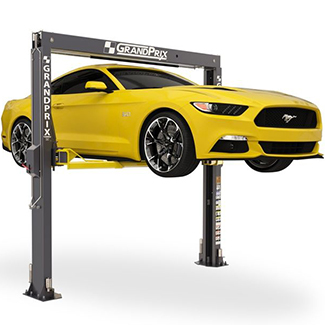
GrandPrix Bi-Metric Lift Arm Configuration
Both symmetric and asymmetric lift arm
configurations are engineered into all
GrandPrix two-post car lifts. Just one more
reason to check out a Grand Prix two-post lift.
This feature offers more door clearance or
center loading. The choice is yours.
Configuration 04
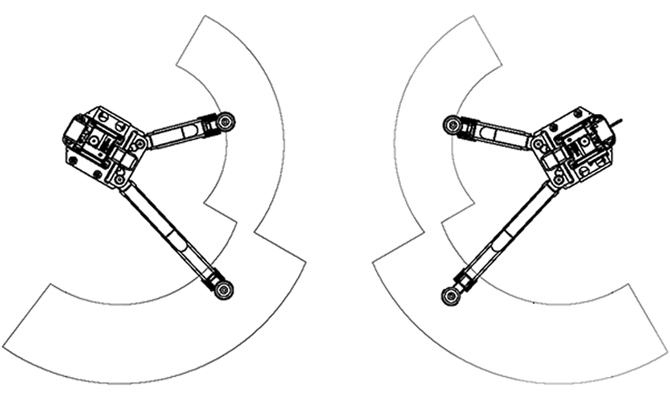
BendPak XPR-10AS Tru-Metric Lift Arm Configuration
Prefer both symmetric and asymmetric lift arm
configurations? Wrenchers can help with that.
Available on BendPak asymmetrical lifts model
XPR-10AS, Tru-Metric arm-design allows variable
arm positions for both symmetrical and
asymmetrical lift arm configurations.
This way your lift has both options available
when you need it. In other words you have the
ability to load vehicles either symmetrically
— centerline of vehicle at column — or
asymmetrically — centerline of vehicle behind
column. Offers greater versatility for added
service capabilities to double your options!
Start With the Vehicles Your Shop Actually Services
Vehicle size, weight distribution, center of gravity,
lifting capacity and lift design all play a role when
evaluating a two-post lift and its lifting-arm
configuration.
Which Lifting-Arm Configuration Works Best for Your Shop?
Think of it as the perfect marriage of geometric angles, and all of them available from Wrenchers. When a two-post auto lift has the right lifting-arm-configuration and corresponding chassis-lift-point design, there is a welcome blend of vehicle balance and lift-pad contact. Different lifting arm configurations are accurately termed Symmetric, Asymmetric, Bi-Metric, or Tru-Metric, and each style in the right application can perform above the rest.
Within the correct parameters, vehicles can set properly on the lift arm pads, doors can open without much conflict near the columns, and the lift’s operation can work well as a team player within your busy day.
Total vehicle length, vehicle weight, and where the center of gravity rests are important aspects to know before selecting a lifting arm configuration
If you are shopping for a two-post auto lift, it’s best to first recognize how “Lifting Arm Configuration” can make your job easier. At Wrenchers we have some useful information to help answer your questions and concerns before you rack your next car or truck. Although this segment is largely about lifting arm configuration, it is worth noting that lift arm configurations generally act as a system with the two-post lift, and pivot from the respective two-post columns’ installed angles.
Make the Best Match
But which lifting arm configuration addresses your shops needs best? Wrenchers offers Symmetric, Asymmetric, Bi-Metric, or Tru-Metric. Each style is engineered to carry loads differently and uniquely enhance vehicle access. Note that Bi-Metric (used on GrandPrix lifts) and Tru-Metric (BendPak XPR-10AS) are distinctive lifting arm designs to add a choice of Symmetric and Asymmetric Lift Arm Configurations to the respective two-post lift.
Typical Vehicle Positioning per lifting arm configuration
Symmetric- Longer, heavier, rear wheel drive vehicle with center of gravity generally at vehicle’s mid-point. Centerline of vehicle at column, posts are squared to each other
Asymmetric- Vehicles with most weight resting near front-door hinge area. Centerline of vehicle behind column, post are rotated 30-degrees outward for easier vehicle access
Selecting the Lifting Arm Configuration for Vehicles You Work On
Determining the best lifting arm configuration begins with evaluating the typical types of vehicles that you will be lifting. Glance through your last month’s repair orders. Is your shop frequented with quick service commuter vehicles? Are you in a rural area where most vehicles are heavier pickup trucks and built for rugged work? Ask your techs which vehicles they typically need to place on a lift. You will also want to determine which weight class capacity and style of lift such as Clearfloor or Floorplate will serve you best. Determining these requirements in the beginning process will help you to determine which lift arm configurations you will have to choose from.
Stay on Balance
One of the important reasons you will want to establish what types of vehicles you usually work on is because of where the center-of-gravity generally exists on the cars and trucks you lift. Do most vehicles seem to be front heavy, do they share weight across the entire length, or are they vehicles that are heavier in the rear? These are important aspects as they relate to vehicle placement, side column-to-door positioning, safety, and lift operation. Plus, when the vehicle’s center of gravity is best matched to a respective lift arm configuration, there is often more working room between the lift’s columns.
Watch Your Weight
Here are some general guidelines for determining common weight bias in vehicle groups. And remember to consider lifting capacity weight when selecting.
Vehicle’s weight rests toward middle-Front engine, rear wheel drive, larger size vehicle. Examples are: Full size RWD sedans, pick-up trucks (typically crew-cab and or long bed, full size SUV, full-size work vans, etc. A Symmetric Lift Arm Configuration generally works well with 50/50 weight balance.
Vehicle’s weight rests toward front-Front Wheel Drive, Transverse mounted engine and transmission, Standard ½-ton pickup trucks-Examples are: FWD 2 and 4 door sedans, smaller SUV’s with FWD, Full-size 2 door short-bed 2wheel drive pickups, etc. An Asymmetric Lift Arm Configuration generally works well with 60/40 weight balance.
Lift Arm Configuration Terms In More Detail
Symmetric Lift Arm Configurations
A “Symmetric” lift arm configuration principally means all four lift arms pivot from columns that are squarely placed across from each other. In other words, both opposing sides of a two-post lift share the same geometry. And the lift arms are configured with approximately the same length, and can often be adjusted to identical lengths.
Columns are positioned squarely to each other
Lift arms squarely pivot at columns and are approximately the same length
Design works best with vehicles that generally have a mid-point center of gravity
Symmetric lifts offered in either Overhead or Floorplate design.
Works well with larger RWD vehicles, SUV’s, ½, ¾, 1 ton crew cab trucks and vans
On some cars, the door may be in line with the post, making it difficult to open doors. Typically with trucks and heavier vehicles, the door is positioned in front of the lift post.
Symmetric lifts are largely used for servicing vehicles that carry their weight almost evenly from bumper to bumper. Larger rear wheel drive vehicles are typical of what works well with this style.
Note to that a symmetric lift’s arms can most often be adjusted to accommodate and lift a smaller front wheel drive vehicle. Albeit most front wheel drive vehicles balance on the lift so that the columns limit door opening access.
Asymmetric Lift Arm Configurations, 30-degree rotated columns for easy vehicle entry
Most of the vehicle’s weight up front? To properly accommodate vehicles with a center of gravity position that rests near the dashboard area (forward of the vehicle’s mid-point), lift engineers designed the asymmetric two-post auto lift. To equally balance this change in weight placement, engineers utilize a system of shorter from lift arms and longer rear lift arms. This nets a vehicle placement that is shorter to the front of the lift columns while longer to the rear of the lift columns. This offset captures the vehicle’s center of gravity very near to the lift’s columns. There is also a big benefit to this style which is the columns are positioned rotated 30-degrees with the wide side facing the rear.
Lift arms pivot asymmetrically at columns
Design works best with vehicles that generally have a forward center of gravity
Works well with FWD vehicles, smaller SUV’s, ½ ton short bed 2WD trucks, etc.
By design the asymmetric style utilizes a lift arm configuration with shorter front arms and longer rear arms. Because this design produces a situation where vehicles sometimes locate on the lift arms with the side doors adjacent to the columns, engineers provided an added benefit by rotating the columns with the 30-degree angled opening toward the rear.
Are you looking for a two post lift that offers both symmetric and asymmetric in one lift? Check out Wrenchers GrandPrix lifts or BendPak’s asymmetric lifts. Each of these have uniquely designed lift arms that include both designs in one.
GrandPrix’s Bi-Metric Lift Arm Configuration offers both symmetric and asymmetric operation
Both symmetric and asymmetric lift arm configurations are engineered into all GrandPrix two-post car lifts. Just one more reason to check out a Grand Prix two-post lift. This feature offers more door clearance or center loading. The choice is yours.
BendPak’s XPR-10AS includes Tru-Metric Lift Arm Configurations-
Prefer both symmetric and asymmetric lift arm configurations? Wrenchers can help with that. Available on BendPak asymmetrical lifts model XPR-10AS, Tru-Metric arm-design allows variable arm positions for both symmetrical and asymmetrical lift arm configurations. This way your lift has both options available when you need it. In other words you have the ability to load vehicles either symmetrically (centerline of vehicle at column) or asymmetrically (centerline of vehicle behind column). Offers greater versatility for added service capabilities to double your options!
Wrenchers offers the following brands with a lift arm configuration to fit any need
Think of it as the perfect marriage of geometric angles, and all of them available from Wrenchers. When a two-post auto lift has the right lifting-arm-configuration and corresponding chassis-lift-point design, there is a welcome blend of vehicle balance and lift-pad contact. Different lifting arm configurations are accurately termed Symmetric, Asymmetric, Bi-Metric, or Tru-Metric, and each style in the right application can perform above the rest.
Within the correct parameters, vehicles can set properly on the lift arm pads, doors can open without much conflict near the columns, and the lift’s operation can work well as a team player within your busy day.
Total vehicle length, vehicle weight, and where the center of gravity rests are important aspects to know before selecting a lifting arm configuration
If you are shopping for a two-post auto lift, it’s best to first recognize how “Lifting Arm Configuration” can make your job easier. At Wrenchers we have some useful information to help answer your questions and concerns before you rack your next car or truck. Although this segment is largely about lifting arm configuration, it is worth noting that lift arm configurations generally act as a system with the two-post lift, and pivot from the respective two-post columns’ installed angles.
Make the Best Match
But which lifting arm configuration addresses your shops needs best? Wrenchers offers Symmetric, Asymmetric, Bi-Metric, or Tru-Metric. Each style is engineered to carry loads differently and uniquely enhance vehicle access. Note that Bi-Metric (used on GrandPrix lifts) and Tru-Metric (BendPak XPR-10AS) are distinctive lifting arm designs to add a choice of Symmetric and Asymmetric Lift Arm Configurations to the respective two-post lift.
Typical Vehicle Positioning per lifting arm configuration
Symmetric- Longer, heavier, rear wheel drive vehicle with center of gravity generally at vehicle’s mid-point. Centerline of vehicle at column, posts are squared to each other
Asymmetric- Vehicles with most weight resting near front-door hinge area. Centerline of vehicle behind column, post are rotated 30-degrees outward for easier vehicle access
Selecting the Lifting Arm Configuration for Vehicles You Work On
Determining the best lifting arm configuration begins with evaluating the typical types of vehicles that you will be lifting. Glance through your last month’s repair orders. Is your shop frequented with quick service commuter vehicles? Are you in a rural area where most vehicles are heavier pickup trucks and built for rugged work? Ask your techs which vehicles they typically need to place on a lift. You will also want to determine which weight class capacity and style of lift such as Clearfloor or Floorplate will serve you best. Determining these requirements in the beginning process will help you to determine which lift arm configurations you will have to choose from.
Stay on Balance
One of the important reasons you will want to establish what types of vehicles you usually work on is because of where the center-of-gravity generally exists on the cars and trucks you lift. Do most vehicles seem to be front heavy, do they share weight across the entire length, or are they vehicles that are heavier in the rear? These are important aspects as they relate to vehicle placement, side column-to-door positioning, safety, and lift operation. Plus, when the vehicle’s center of gravity is best matched to a respective lift arm configuration, there is often more working room between the lift’s columns.
Watch Your Weight
Here are some general guidelines for determining common weight bias in vehicle groups. And remember to consider lifting capacity weight when selecting.
Vehicle’s weight rests toward middle-Front engine, rear wheel drive, larger size vehicle. Examples are: Full size RWD sedans, pick-up trucks (typically crew-cab and or long bed, full size SUV, full-size work vans, etc. A Symmetric Lift Arm Configuration generally works well with 50/50 weight balance.
Vehicle’s weight rests toward front-Front Wheel Drive, Transverse mounted engine and transmission, Standard ½-ton pickup trucks-Examples are: FWD 2 and 4 door sedans, smaller SUV’s with FWD, Full-size 2 door short-bed 2wheel drive pickups, etc. An Asymmetric Lift Arm Configuration generally works well with 60/40 weight balance.
Lift Arm Configuration Terms In More Detail
Symmetric Lift Arm Configurations
A “Symmetric” lift arm configuration principally means all four lift arms pivot from columns that are squarely placed across from each other. In other words, both opposing sides of a two-post lift share the same geometry. And the lift arms are configured with approximately the same length, and can often be adjusted to identical lengths.
Columns are positioned squarely to each other
Lift arms squarely pivot at columns and are approximately the same length
Design works best with vehicles that generally have a mid-point center of gravity
Symmetric lifts offered in either Overhead or Floorplate design.
Works well with larger RWD vehicles, SUV’s, ½, ¾, 1 ton crew cab trucks and vans
On some cars, the door may be in line with the post, making it difficult to open doors. Typically with trucks and heavier vehicles, the door is positioned in front of the lift post.
Symmetric lifts are largely used for servicing vehicles that carry their weight almost evenly from bumper to bumper. Larger rear wheel drive vehicles are typical of what works well with this style.
Note to that a symmetric lift’s arms can most often be adjusted to accommodate and lift a smaller front wheel drive vehicle. Albeit most front wheel drive vehicles balance on the lift so that the columns limit door opening access.
Asymmetric Lift Arm Configurations, 30-degree rotated columns for easy vehicle entry
Most of the vehicle’s weight up front? To properly accommodate vehicles with a center of gravity position that rests near the dashboard area (forward of the vehicle’s mid-point), lift engineers designed the asymmetric two-post auto lift. To equally balance this change in weight placement, engineers utilize a system of shorter from lift arms and longer rear lift arms. This nets a vehicle placement that is shorter to the front of the lift columns while longer to the rear of the lift columns. This offset captures the vehicle’s center of gravity very near to the lift’s columns. There is also a big benefit to this style which is the columns are positioned rotated 30-degrees with the wide side facing the rear.
Lift arms pivot asymmetrically at columns
Design works best with vehicles that generally have a forward center of gravity
Works well with FWD vehicles, smaller SUV’s, ½ ton short bed 2WD trucks, etc.
By design the asymmetric style utilizes a lift arm configuration with shorter front arms and longer rear arms. Because this design produces a situation where vehicles sometimes locate on the lift arms with the side doors adjacent to the columns, engineers provided an added benefit by rotating the columns with the 30-degree angled opening toward the rear.
Are you looking for a two post lift that offers both symmetric and asymmetric in one lift? Check out Wrenchers GrandPrix lifts or BendPak’s asymmetric lifts. Each of these have uniquely designed lift arms that include both designs in one.
GrandPrix’s Bi-Metric Lift Arm Configuration offers both symmetric and asymmetric operation
Both symmetric and asymmetric lift arm configurations are engineered into all GrandPrix two-post car lifts. Just one more reason to check out a Grand Prix two-post lift. This feature offers more door clearance or center loading. The choice is yours.
BendPak’s XPR-10AS includes Tru-Metric Lift Arm Configurations-
Prefer both symmetric and asymmetric lift arm configurations? Wrenchers can help with that. Available on BendPak asymmetrical lifts model XPR-10AS, Tru-Metric arm-design allows variable arm positions for both symmetrical and asymmetrical lift arm configurations. This way your lift has both options available when you need it. In other words you have the ability to load vehicles either symmetrically (centerline of vehicle at column) or asymmetrically (centerline of vehicle behind column). Offers greater versatility for added service capabilities to double your options!
Wrenchers offers the following brands with a lift arm configuration to fit any need